what distance did the person move from t = 2.0 s to t= 4.0 s?
three Motion Along a Direct Line
3.half-dozen Finding Velocity and Displacement from Acceleration
Learning Objectives
By the stop of this section, yous will exist able to:
- Derive the kinematic equations for constant acceleration using integral calculus.
- Use the integral conception of the kinematic equations in analyzing motion.
- Observe the functional form of velocity versus time given the acceleration part.
- Find the functional form of position versus time given the velocity part.
This section assumes yous accept enough background in calculus to exist familiar with integration. In Instantaneous Velocity and Speed and Average and Instantaneous Acceleration nosotros introduced the kinematic functions of velocity and acceleration using the derivative. By taking the derivative of the position function we found the velocity office, and likewise past taking the derivative of the velocity function we found the acceleration function. Using integral calculus, we can work backward and calculate the velocity function from the acceleration function, and the position function from the velocity function.
Kinematic Equations from Integral Calculus
Let'southward begin with a particle with an dispatch a(t) is a known function of fourth dimension. Since the time derivative of the velocity function is acceleration,
![\[\frac{d}{dt}v(t)=a(t),\]](https://opentextbc.ca/universityphysicsv1openstax/wp-content/ql-cache/quicklatex.com-80d4e6535a59e51b1fe2e5aafdd815bb_l3.png "Rendered by QuickLaTeX.com")
nosotros tin can take the indefinite integral of both sides, finding
![\[\int \frac{d}{dt}v(t)dt=\int a(t)dt+{C}_{1},\]](https://opentextbc.ca/universityphysicsv1openstax/wp-content/ql-cache/quicklatex.com-c189d984eecf89b2721054dfcfc052e5_l3.png "Rendered by QuickLaTeX.com")
where C 1 is a abiding of integration. Since
![\[\int \frac{d}{dt}v(t)dt=v(t)\]](https://opentextbc.ca/universityphysicsv1openstax/wp-content/ql-cache/quicklatex.com-85c0bb56cad9277524dcc87473e4b3e2_l3.png "Rendered by QuickLaTeX.com")
, the velocity is given by
![\[v(t)=\int a(t)dt+{C}_{1}.\]](https://opentextbc.ca/universityphysicsv1openstax/wp-content/ql-cache/quicklatex.com-1ae59e2643845615ab3334e398537352_l3.png "Rendered by QuickLaTeX.com")
Similarly, the time derivative of the position function is the velocity function,
![\[\frac{d}{dt}x(t)=v(t).\]](https://opentextbc.ca/universityphysicsv1openstax/wp-content/ql-cache/quicklatex.com-259f03abac5eb0b18fa872a0eec6b292_l3.png "Rendered by QuickLaTeX.com")
Thus, we can use the same mathematical manipulations we just used and find
![\[x(t)=\int v(t)dt+{C}_{2},\]](https://opentextbc.ca/universityphysicsv1openstax/wp-content/ql-cache/quicklatex.com-0f0d6a4a4a0537d305c47a2f6e80e3eb_l3.png "Rendered by QuickLaTeX.com")
where C 2 is a second constant of integration.
We can derive the kinematic equations for a abiding dispatch using these integrals. With a(t) = a a constant, and doing the integration in (Figure), nosotros observe
![\[v(t)=\int adt+{C}_{1}=at+{C}_{1}.\]](https://opentextbc.ca/universityphysicsv1openstax/wp-content/ql-cache/quicklatex.com-87d9ebd12c6ae80ea4e6f4d41a4c27b3_l3.png "Rendered by QuickLaTeX.com")
If the initial velocity is 5(0) = v 0, then
![\[{v}_{0}=0+{C}_{1}.\]](https://opentextbc.ca/universityphysicsv1openstax/wp-content/ql-cache/quicklatex.com-848eb1e7551650b8fd97611207e10d6d_l3.png "Rendered by QuickLaTeX.com")
Then, C 1 = five 0 and
![\[v(t)={v}_{0}+at,\]](https://opentextbc.ca/universityphysicsv1openstax/wp-content/ql-cache/quicklatex.com-af832d345934740e6829b6fed07454a0_l3.png "Rendered by QuickLaTeX.com")
which is (Equation). Substituting this expression into (Effigy) gives
![\[x(t)=\int ({v}_{0}+at)dt+{C}_{2}.\]](https://opentextbc.ca/universityphysicsv1openstax/wp-content/ql-cache/quicklatex.com-ec48d0b7eb86cfca30483489d54f3fe3_l3.png "Rendered by QuickLaTeX.com")
Doing the integration, nosotros find
![\[x(t)={v}_{0}t+\frac{1}{2}a{t}^{2}+{C}_{2}.\]](https://opentextbc.ca/universityphysicsv1openstax/wp-content/ql-cache/quicklatex.com-3906f069562e0bad6a6c34ebc6ea20a3_l3.png "Rendered by QuickLaTeX.com")
If x(0) = x 0, we take
![\[{x}_{0}=0+0+{C}_{2};\]](https://opentextbc.ca/universityphysicsv1openstax/wp-content/ql-cache/quicklatex.com-e184f1a58c3b2fe028fca80266eb1e21_l3.png "Rendered by QuickLaTeX.com")
and then, C 2 = x 0. Substituting back into the equation for x(t), we finally take
![\[x(t)={x}_{0}+{v}_{0}t+\frac{1}{2}a{t}^{2},\]](https://opentextbc.ca/universityphysicsv1openstax/wp-content/ql-cache/quicklatex.com-67b01af27aa7d31948d61a970e27597a_l3.png "Rendered by QuickLaTeX.com")
which is (Equation).
Example
Motility of a Motorboat
A motorboat is traveling at a constant velocity of 5.0 thousand/s when it starts to decelerate to go far at the dock. Its acceleration is
![\[a(t)=-\frac{1}{4}t\,\text{m/}{\text{s}}^{2}\]](https://opentextbc.ca/universityphysicsv1openstax/wp-content/ql-cache/quicklatex.com-2f70f90acceb33a7c66a57a718918e35_l3.png "Rendered by QuickLaTeX.com")
. (a) What is the velocity function of the motorboat? (b) At what time does the velocity reach cypher? (c) What is the position function of the motorboat? (d) What is the deportation of the motorboat from the time it begins to decelerate to when the velocity is zilch? (east) Graph the velocity and position functions.
Strategy
(a) To get the velocity function we must integrate and use initial atmospheric condition to observe the constant of integration. (b) We fix the velocity function equal to naught and solve for t. (c) Similarly, nosotros must integrate to find the position role and apply initial atmospheric condition to find the abiding of integration. (d) Since the initial position is taken to exist zero, we merely have to evaluate the position office at
![\[t=0\]](https://opentextbc.ca/universityphysicsv1openstax/wp-content/ql-cache/quicklatex.com-7c51d4cdda801c97dd883c5e9381905f_l3.png "Rendered by QuickLaTeX.com")
.
Solution
We take t = 0 to be the time when the boat starts to decelerate.
- From the functional form of the acceleration nosotros can solve (Effigy) to get v(t):
[reveal-answer q="136447″]Show Answer[/reveal-answer]
[hidden-answer a="136447″]![\[v(t)=\int a(t)dt+{C}_{1}=\int -\frac{1}{4}tdt+{C}_{1}=-\frac{1}{8}{t}^{2}+{C}_{1}.\]](https://opentextbc.ca/universityphysicsv1openstax/wp-content/ql-cache/quicklatex.com-4149522defa6afd40de8a9d5c79898d6_l3.png "Rendered by QuickLaTeX.com")
At t = 0 we have v(0) = v.0 k/s = 0 + C1, so C1 = v.0 m/s or
![\[v(t)=5.0\,\text{m/}\text{s}-\frac{1}{8}{t}^{2}\]](https://opentextbc.ca/universityphysicsv1openstax/wp-content/ql-cache/quicklatex.com-cf84c8e54bcdb037d0b077f5e28eca0d_l3.png "Rendered by QuickLaTeX.com")
.[/subconscious-answer]
- [reveal-answer q="967265″]Show Answer[/reveal-respond]
[hidden-answer a="967265″]![\[v(t)=0=5.0\,\text{m/}\text{s}-\frac{1}{8}{t}^{2}⇒t=6.3\,\text{s}\]](https://opentextbc.ca/universityphysicsv1openstax/wp-content/ql-cache/quicklatex.com-b1712a949f5eb526d8fd6c25654b85ba_l3.png "Rendered by QuickLaTeX.com")
[/hidden-answer]
- Solve (Figure):
[reveal-answer q="251505″]Prove Respond[/reveal-answer]
[subconscious-reply a="251505″]![\[x(t)=\int v(t)dt+{C}_{2}=\int (5.0-\frac{1}{8}{t}^{2})dt+{C}_{2}=5.0t-\frac{1}{24}{t}^{3}+{C}_{2}.\]](https://opentextbc.ca/universityphysicsv1openstax/wp-content/ql-cache/quicklatex.com-1ccb74db86d1ecc4e6943adf8f2e0c45_l3.png "Rendered by QuickLaTeX.com")
At t = 0, we fix x(0) = 0 = x0, since nosotros are simply interested in the displacement from when the gunkhole starts to decelerate. We have
![\[x(0)=0={C}_{2}.\]](https://opentextbc.ca/universityphysicsv1openstax/wp-content/ql-cache/quicklatex.com-4a9da02317fed5c05e45ad44ce216f4d_l3.png "Rendered by QuickLaTeX.com")
Therefore, the equation for the position is
![\[x(t)=5.0t-\frac{1}{24}{t}^{3}.\]](https://opentextbc.ca/universityphysicsv1openstax/wp-content/ql-cache/quicklatex.com-2677fd02c9f30b82b1f1d2b4282d185d_l3.png "Rendered by QuickLaTeX.com")
[/hidden-answer]
- [reveal-reply q="330950″]Prove Answer[/reveal-answer]
[hidden-respond a="330950″]Since the initial position is taken to exist goose egg, we but accept to evaluate x(t) when the velocity is zero. This occurs at t = 6.3 southward. Therefore, the deportation is![\[x(6.3)=5.0(6.3)-\frac{1}{24}{(6.3)}^{3}=21.1\,\text{m}\text{.}\]](https://opentextbc.ca/universityphysicsv1openstax/wp-content/ql-cache/quicklatex.com-493a29298d31612af5c8b71b0abb0518_l3.png "Rendered by QuickLaTeX.com")
[/hidden-answer]
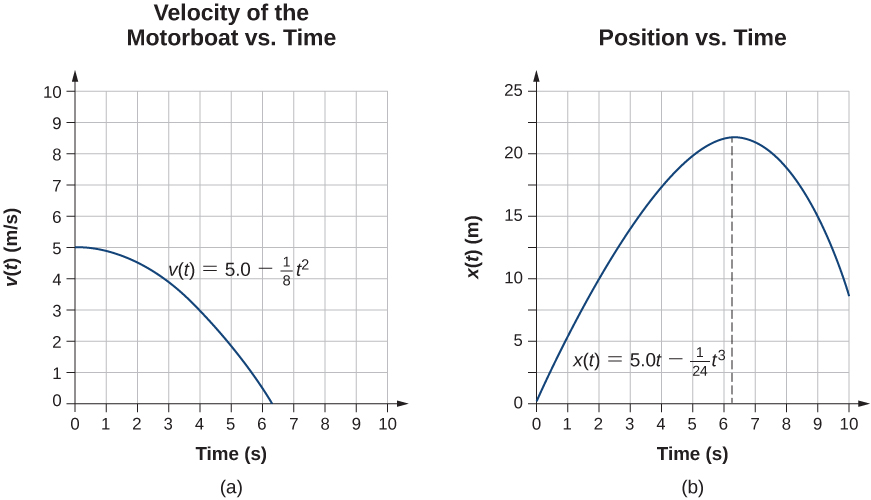
Significance
The dispatch role is linear in fourth dimension then the integration involves simple polynomials. In (Figure), we see that if we extend the solution beyond the point when the velocity is null, the velocity becomes negative and the boat reverses direction. This tells u.s.a. that solutions can requite u.s. data outside our immediate interest and we should be careful when interpreting them.
Check Your Understanding
A particle starts from rest and has an dispatch function
![\[5-10t{\text{m/s}}^{2}\]](https://opentextbc.ca/universityphysicsv1openstax/wp-content/ql-cache/quicklatex.com-5c45ac3e00866e9592144ca2f81ce0c0_l3.png "Rendered by QuickLaTeX.com")
. (a) What is the velocity function? (b) What is the position function? (c) When is the velocity zero?
[reveal-answer q="fs-id1168057352922″]Prove Solution[/reveal-answer]
[hidden-respond a="fs-id1168057352922″]
- The velocity function is the integral of the acceleration function plus a constant of integration. By (Figure),
![\[v(t)=\int a(t)dt+{C}_{1}=\int (5-10t)dt+{C}_{1}=5t-5{t}^{2}+{C}_{1}.\]](https://opentextbc.ca/universityphysicsv1openstax/wp-content/ql-cache/quicklatex.com-7f14c330b38a6fa029db5a238bb6538b_l3.png "Rendered by QuickLaTeX.com")
Since v(0) = 0, nosotros have C i = 0; so,
![\[v(t)=5t-5{t}^{2}.\]](https://opentextbc.ca/universityphysicsv1openstax/wp-content/ql-cache/quicklatex.com-077e815b02ae539626b669171489f306_l3.png "Rendered by QuickLaTeX.com")
- By (Figure),
![\[x(t)=\int v(t)dt+{C}_{2}=\int (5t-5{t}^{2})dt+{C}_{2}=\frac{5}{2}{t}^{2}-\frac{5}{3}{t}^{3}+{C}_{2}\]](https://opentextbc.ca/universityphysicsv1openstax/wp-content/ql-cache/quicklatex.com-b5889f453df59210c462d27ffeb80b62_l3.png "Rendered by QuickLaTeX.com")
.Since x(0) = 0, nosotros have C ii = 0, and
![\[x(t)=\frac{5}{2}{t}^{2}-\frac{5}{3}{t}^{3}.\]](https://opentextbc.ca/universityphysicsv1openstax/wp-content/ql-cache/quicklatex.com-5c2cbaaa6565f1616a13b061417bcaaf_l3.png "Rendered by QuickLaTeX.com")
- The velocity can be written every bit v(t) = 5t(ane – t), which equals nix at t = 0, and t = ane due south.
[/hidden-reply]
Summary
- Integral calculus gives u.s.a. a more than consummate conception of kinematics.
- If acceleration a(t) is known, we can use integral calculus to derive expressions for velocity v(t) and position 10(t).
- If dispatch is constant, the integral equations reduce to (Figure) and (Figure) for movement with abiding acceleration.
Central Equations
| Displacement | |
| Total displacement | |
| Average velocity | |
| Instantaneous velocity | |
| Average speed | |
| Instantaneous speed | |
| Average acceleration | |
| Instantaneous acceleration | |
| Position from average velocity | |
| Average velocity | |
| Velocity from dispatch | |
| Position from velocity and acceleration | |
| Velocity from distance | |
| Velocity of gratis fall | |
| Height of free fall | |
| Velocity of complimentary autumn from height | |
| Velocity from acceleration | |
| Position from velocity | |
![\[\text{Δ}x={x}_{\text{f}}-{x}_{\text{i}}\]](https://opentextbc.ca/universityphysicsv1openstax/wp-content/ql-cache/quicklatex.com-96dbe97b8edf61706892e14c4def0fbc_l3.png "Rendered by QuickLaTeX.com")
![\[\text{Δ}{x}_{\text{Total}}=\sum \text{Δ}{x}_{\text{i}}\]](https://opentextbc.ca/universityphysicsv1openstax/wp-content/ql-cache/quicklatex.com-5ac9affd60bfe155c9e15f507bed36dd_l3.png "Rendered by QuickLaTeX.com")
![\[\overset{\text{-}}{v}=\frac{\text{Δ}x}{\text{Δ}t}=\frac{{x}_{2}-{x}_{1}}{{t}_{2}-{t}_{1}}\]](https://opentextbc.ca/universityphysicsv1openstax/wp-content/ql-cache/quicklatex.com-0e6ce20beb8778f90f777e26ec411833_l3.png "Rendered by QuickLaTeX.com")
![\[v(t)=\frac{dx(t)}{dt}\]](https://opentextbc.ca/universityphysicsv1openstax/wp-content/ql-cache/quicklatex.com-69eed31de8833a2febe438006e23e791_l3.png "Rendered by QuickLaTeX.com")
![\[\text{Average speed}=\overset{\text{-}}{s}=\frac{\text{Total distance}}{\text{Elapsed time}}\]](https://opentextbc.ca/universityphysicsv1openstax/wp-content/ql-cache/quicklatex.com-5903127859207d0c14a4bf5ea6540202_l3.png "Rendered by QuickLaTeX.com")
![\[\text{Instantaneous speed}=|v(t)|\]](https://opentextbc.ca/universityphysicsv1openstax/wp-content/ql-cache/quicklatex.com-93fecc73f80899b0a2fc82dfd1b5d17d_l3.png "Rendered by QuickLaTeX.com")
![\[\overset{\text{-}}{a}=\frac{\text{Δ}v}{\text{Δ}t}=\frac{{v}_{f}-{v}_{0}}{{t}_{f}-{t}_{0}}\]](https://opentextbc.ca/universityphysicsv1openstax/wp-content/ql-cache/quicklatex.com-adaa1d4d7eae5a68644f09986526e58f_l3.png "Rendered by QuickLaTeX.com")
![\[a(t)=\frac{dv(t)}{dt}\]](https://opentextbc.ca/universityphysicsv1openstax/wp-content/ql-cache/quicklatex.com-56f95843f956276c56a82a7792c7a14c_l3.png "Rendered by QuickLaTeX.com")
![\[x={x}_{0}+\overset{\text{-}}{v}t\]](https://opentextbc.ca/universityphysicsv1openstax/wp-content/ql-cache/quicklatex.com-58e23956bb081454398346eb493d9e47_l3.png "Rendered by QuickLaTeX.com")
![\[\overset{\text{-}}{v}=\frac{{v}_{0}+v}{2}\]](https://opentextbc.ca/universityphysicsv1openstax/wp-content/ql-cache/quicklatex.com-d508edf1e3efc6f0da8ac9d91a32a1e4_l3.png "Rendered by QuickLaTeX.com")
![\[v={v}_{0}+at\enspace(\text{constant}\,a\text{)}\]](https://opentextbc.ca/universityphysicsv1openstax/wp-content/ql-cache/quicklatex.com-f8a814c3ad86dd69d668cb037f3b535c_l3.png "Rendered by QuickLaTeX.com")
![\[x={x}_{0}+{v}_{0}t+\frac{1}{2}a{t}^{2}\enspace(\text{constant}\,a\text{)}\]](https://opentextbc.ca/universityphysicsv1openstax/wp-content/ql-cache/quicklatex.com-bb1a4b7d596a09bbcc25095b58237dd5_l3.png "Rendered by QuickLaTeX.com")
![\[{v}^{2}={v}_{0}^{2}+2a(x-{x}_{0})\enspace(\text{constant}\,a\text{)}\]](https://opentextbc.ca/universityphysicsv1openstax/wp-content/ql-cache/quicklatex.com-cb3c665f5335e8a59a35d55bfe8fb774_l3.png "Rendered by QuickLaTeX.com")
![\[v={v}_{0}-gt\,\text{(positive upward)}\]](https://opentextbc.ca/universityphysicsv1openstax/wp-content/ql-cache/quicklatex.com-fd13db69170b2f1c88adb1e02687a15b_l3.png "Rendered by QuickLaTeX.com")
![\[y={y}_{0}+{v}_{0}t-\frac{1}{2}g{t}^{2}\]](https://opentextbc.ca/universityphysicsv1openstax/wp-content/ql-cache/quicklatex.com-b22fcb17cd4aae43669a077fd97a0032_l3.png "Rendered by QuickLaTeX.com")
![\[{v}^{2}={v}_{0}^{2}-2g(y-{y}_{0})\]](https://opentextbc.ca/universityphysicsv1openstax/wp-content/ql-cache/quicklatex.com-91ddb59b914588d6175b1792effec408_l3.png "Rendered by QuickLaTeX.com")
![\[v(t)=\int a(t)dt+{C}_{1}\]](https://opentextbc.ca/universityphysicsv1openstax/wp-content/ql-cache/quicklatex.com-84e74ce2751418da47f088de1dceb099_l3.png "Rendered by QuickLaTeX.com")
![\[x(t)=\int v(t)dt+{C}_{2}\]](https://opentextbc.ca/universityphysicsv1openstax/wp-content/ql-cache/quicklatex.com-b95dcd78b469ff4abf300e93c9fc3b56_l3.png "Rendered by QuickLaTeX.com")
Conceptual Questions
When given the acceleration part, what boosted information is needed to discover the velocity part and position role?
Problems
The acceleration of a particle varies with time according to the equation
![\[a(t)=p{t}^{2}-q{t}^{3}\]](https://opentextbc.ca/universityphysicsv1openstax/wp-content/ql-cache/quicklatex.com-1c07188f315f1578c50ac626ab9ba2f3_l3.png "Rendered by QuickLaTeX.com")
. Initially, the velocity and position are cypher. (a) What is the velocity as a function of time? (b) What is the position as a function of fourth dimension?
Between t = 0 and t = t 0, a rocket moves straight upward with an acceleration given by
![\[a(t)=A-B{t}^{1\,\text{/}2}\]](https://opentextbc.ca/universityphysicsv1openstax/wp-content/ql-cache/quicklatex.com-08e3d468f08461cfc0e29f213fdb5ed5_l3.png "Rendered by QuickLaTeX.com")
, where A and B are constants. (a) If x is in meters and t is in seconds, what are the units of A and B? (b) If the rocket starts from rest, how does the velocity vary between t = 0 and t = t 0? (c) If its initial position is zip, what is the rocket'due south position as a function of time during this same time interval?
[reveal-answer q="fs-id1168055134758″]Show Solution[/reveal-answer]
[subconscious-answer a="fs-id1168055134758″]
a.
![\[A={\text{m/s}}^{2}\enspaceB={\text{m/s}}^{5\,\text{/}2}\]](https://opentextbc.ca/universityphysicsv1openstax/wp-content/ql-cache/quicklatex.com-f3fbaa6fa83fb3f71ccfd860c7ead80b_l3.png "Rendered by QuickLaTeX.com")
;
b.
![\[\begin{array}{cc} v(t)=\int a(t)dt+{C}_{1}=\int (A-B{t}^{1\,\text{/}2})dt+{C}_{1}=At-\frac{2}{3}B{t}^{3\,\text{/}2}+{C}_{1}\hfill \\ v(0)=0={C}_{1}\enspace\text{so}\enspacev({t}_{0})=A{t}_{0}-\frac{2}{3}B{t}_{0}^{\text{3/2}}\hfill \end{array}\]](https://opentextbc.ca/universityphysicsv1openstax/wp-content/ql-cache/quicklatex.com-e358acd0dfaea1e5aa34c2ed4f3a1549_l3.png "Rendered by QuickLaTeX.com")
;
c.
![\[\begin{array}{cc} x(t)=\int v(t)dt+{C}_{2}=\int (At-\frac{2}{3}B{t}^{3\,\text{/}2})dt+{C}_{2}=\frac{1}{2}A{t}^{2}-\frac{4}{15}B{t}^{5\,\text{/}2}+{C}_{2}\hfill \\ x(0)=0={C}_{2}\enspace\text{so}\enspacex({t}_{0})=\frac{1}{2}A{t}_{0}^{2}-\frac{4}{15}B{t}_{0}^{\text{5/2}}\hfill \end{array}\]](https://opentextbc.ca/universityphysicsv1openstax/wp-content/ql-cache/quicklatex.com-c8400d8875338ad0023e51bdf87135ac_l3.png "Rendered by QuickLaTeX.com")
[/hidden-respond]
The velocity of a particle moving forth the x-axis varies with time co-ordinate to
![\[v(t)=A+B{t}^{-1}\]](https://opentextbc.ca/universityphysicsv1openstax/wp-content/ql-cache/quicklatex.com-e8659647571cec7a00bbfb2491200462_l3.png "Rendered by QuickLaTeX.com")
, where A = 2 m/s, B = 0.25 yard, and
![\[1.0\,\text{s}\le t\le 8.0\,\text{s}\]](https://opentextbc.ca/universityphysicsv1openstax/wp-content/ql-cache/quicklatex.com-a3cf2a685c8874bcd78d23122b6be8ad_l3.png "Rendered by QuickLaTeX.com")
. Determine the dispatch and position of the particle at t = 2.0 south and t = five.0 southward. Assume that
![\[x(t=1\,\text{s})=0\]](https://opentextbc.ca/universityphysicsv1openstax/wp-content/ql-cache/quicklatex.com-547eb332384f9056e9c6ae2975157592_l3.png "Rendered by QuickLaTeX.com")
.
A particle at balance leaves the origin with its velocity increasing with time according to v(t) = iii.2t m/s. At v.0 s, the particle'southward velocity starts decreasing according to [16.0 – ane.5(t – 5.0)] m/s. This decrease continues until t = 11.0 south, afterwards which the particle'southward velocity remains constant at 7.0 m/southward. (a) What is the acceleration of the particle as a function of fourth dimension? (b) What is the position of the particle at t = 2.0 s, t = 7.0 south, and t = 12.0 due south?
[reveal-answer q="fs-id1168055121296″]Testify Solution[/reveal-answer]
[subconscious-respond a="fs-id1168055121296″]
a.
![\[\begin{array}{cc} a(t)=3.2{\text{m/s}}^{2}\enspacet\le 5.0\,\text{s}\hfill \\ a(t)=1.5{\text{m/s}}^{2}\enspace5.0\,\text{s}\le t\le 11.0\,\text{s}\hfill \\ a(t)=0{\text{m/s}}^{2}\enspacet>11.0\,\text{s}\hfill \end{array}\]](https://opentextbc.ca/universityphysicsv1openstax/wp-content/ql-cache/quicklatex.com-eb69aedcd317e7edcd10d3150e390785_l3.png "Rendered by QuickLaTeX.com")
;
b.
![\[\begin{array}{cc} x(t)=\int v(t)dt+{C}_{2}=\int 3.2tdt+{C}_{2}=1.6{t}^{2}+{C}_{2}\hfill \\ \quad t\le 5.0\,\text{s}\hfill \\ x(0)=0⇒{C}_{2}=0\enspace\text{therefore,}\,x(2.0\,\text{s})=6.4\,\text{m}\hfill \\ x(t)=\int v(t)dt+{C}_{2}=\int [16.0-1.5(t-5.0)]dt+{C}_{2}=16t-1.5(\frac{{t}^{2}}{2}-5.0t)+{C}_{2}\hfill \\ 5.0\le t\le 11.0\,\text{s}\hfill \\ x(5\,\text{s})=1.6{(5.0)}^{2}=40\,\text{m}=16(5.0\,\text{s})-1.5(\frac{{5}^{2}}{2}-5.0(5.0))+{C}_{2}\hfill \\ \quad 40=98.75+{C}_{2}⇒{C}_{2}=-58.75\hfill \\ x(7.0\,\text{s})=16(7.0)-1.5(\frac{{7}^{2}}{2}-5.0(7))-58.75=69\,\text{m}\hfill \\ \quad x(t)=\int 7.0dt+{C}_{2}=7t+{C}_{2}\hfill \\ \phantom{\rule{1.5em}{0ex}}t\ge 11.0\,\text{s}\hfill \\ x(11.0\,\text{s})=16(11)-1.5(\frac{{11}^{2}}{2}-5.0(11))-58.75=109=7(11.0\,\text{s})+{C}_{2}⇒{C}_{2}=32\,\text{m}\hfill \\ \quad x(t)=7t+32\,\text{m}\hfill \\ \phantom{\rule{1.5em}{0ex}}x\ge 11.0\,\text{s}⇒x(12.0\,\text{s})=7(12)+32=116\,\text{m}\hfill \end{array}\]](https://opentextbc.ca/universityphysicsv1openstax/wp-content/ql-cache/quicklatex.com-3760292df8d15ef5739eb14d44e0d6fe_l3.png "Rendered by QuickLaTeX.com")
[/hidden-respond]
Boosted Problems
Professional baseball player Nolan Ryan could pitch a baseball game at approximately 160.0 km/h. At that average velocity, how long did it have a ball thrown past Ryan to reach home plate, which is xviii.iv thousand from the pitcher'south mound? Compare this with the boilerplate reaction time of a homo to a visual stimulus, which is 0.25 due south.
An airplane leaves Chicago and makes the 3000-km trip to Los Angeles in v.0 h. A second plane leaves Chicago i-half hour later and arrives in Los Angeles at the same time. Compare the average velocities of the 2 planes. Ignore the curvature of Globe and the difference in altitude between the two cities.
[reveal-answer q="fs-id1168055151090″]Bear witness Solution[/reveal-answer]
[hidden-answer a="fs-id1168055151090″]
Take west to be the positive management.
1st plane:
![\[\overset{\text{-}}{\nu }=600\,\text{km/h}\]](https://opentextbc.ca/universityphysicsv1openstax/wp-content/ql-cache/quicklatex.com-47fa3c157d189ba0dd9e6d2e73e515a0_l3.png "Rendered by QuickLaTeX.com")
2nd plane
![\[\overset{\text{-}}{\nu }=667.0\,\text{km/h}\]](https://opentextbc.ca/universityphysicsv1openstax/wp-content/ql-cache/quicklatex.com-e79a1697da2a221586201f48f10bf594_l3.png "Rendered by QuickLaTeX.com")
[/subconscious-answer]
Unreasonable Results A cyclist rides 16.0 km east, so 8.0 km west, then 8.0 km east, then 32.0 km w, and finally 11.ii km eastward. If his average velocity is 24 km/h, how long did information technology accept him to complete the trip? Is this a reasonable time?
An object has an acceleration of
![\[+1.2\,{\text{cm/s}}^{2}\]](https://opentextbc.ca/universityphysicsv1openstax/wp-content/ql-cache/quicklatex.com-02f73700a9155271e1c4d93d0cfaa248_l3.png "Rendered by QuickLaTeX.com")
. At
![\[t=4.0\,\text{s}\]](https://opentextbc.ca/universityphysicsv1openstax/wp-content/ql-cache/quicklatex.com-556be06fcc7b5cf7fe2fc8ec824f6eb6_l3.png "Rendered by QuickLaTeX.com")
, its velocity is
![\[-3.4\,\text{cm/s}\]](https://opentextbc.ca/universityphysicsv1openstax/wp-content/ql-cache/quicklatex.com-8238f2690c384b60c4c8cc3c3ea95333_l3.png "Rendered by QuickLaTeX.com")
. Determine the object's velocities at
![\[t=1.0\,\text{s}\]](https://opentextbc.ca/universityphysicsv1openstax/wp-content/ql-cache/quicklatex.com-32fee12e5ecb9fda77a69bf1b2dbb969_l3.png "Rendered by QuickLaTeX.com")
and
![\[t=6.0\,\text{s}\]](https://opentextbc.ca/universityphysicsv1openstax/wp-content/ql-cache/quicklatex.com-88bdfd3b5ab737d9da567495575797dc_l3.png "Rendered by QuickLaTeX.com")
.
[reveal-answer q="fs-id1168055302745″]Evidence Solution[/reveal-answer]
[hidden-answer a="fs-id1168055302745″]
![\[a=\frac{v-{v}_{0}}{t-{t}_{0}}\]](https://opentextbc.ca/universityphysicsv1openstax/wp-content/ql-cache/quicklatex.com-3458e0a6212c191a4f93ecf540cb4e59_l3.png "Rendered by QuickLaTeX.com")
,
![\[t=0,\,a=\frac{-3.4\,\text{cm/s}-{v}_{0}}{4\,\text{s}}=1.2\,{\text{cm/s}}^{2}⇒{v}_{0}=-8.2\,\text{cm/s}\]](https://opentextbc.ca/universityphysicsv1openstax/wp-content/ql-cache/quicklatex.com-7dd090c74e1866090a8a25171c8588ca_l3.png "Rendered by QuickLaTeX.com")
![\[v={v}_{0}+at=-8.2+1.2\,t\]](https://opentextbc.ca/universityphysicsv1openstax/wp-content/ql-cache/quicklatex.com-c65c0dc45aa932297955b2cc412bc7dc_l3.png "Rendered by QuickLaTeX.com")
;
![\[v=-7.0\,\text{cm/s}\enspacev=-1.0\,\text{cm/s}\]](https://opentextbc.ca/universityphysicsv1openstax/wp-content/ql-cache/quicklatex.com-2ec936f211555c353d6b4b6ba64bfae5_l3.png "Rendered by QuickLaTeX.com")
[/hidden-answer]
A particle moves forth the 10-axis according to the equation
![\[x(t)=2.0-4.0{t}^{2}\]](https://opentextbc.ca/universityphysicsv1openstax/wp-content/ql-cache/quicklatex.com-a242d4eeabb2e2cf58d916a901141b83_l3.png "Rendered by QuickLaTeX.com")
yard. What are the velocity and acceleration at
![\[t=2.0\]](https://opentextbc.ca/universityphysicsv1openstax/wp-content/ql-cache/quicklatex.com-6ac44bce3c129e4d1bc22b130bd3aad8_l3.png "Rendered by QuickLaTeX.com")
south and
![\[t=5.0\]](https://opentextbc.ca/universityphysicsv1openstax/wp-content/ql-cache/quicklatex.com-b325ecb77b1cf8286fecd9fffa3ff9f4_l3.png "Rendered by QuickLaTeX.com")
s?
A particle moving at abiding dispatch has velocities of
![\[2.0\,\text{m/s}\]](https://opentextbc.ca/universityphysicsv1openstax/wp-content/ql-cache/quicklatex.com-ddd5e72702c74f4a3018d122026064dc_l3.png "Rendered by QuickLaTeX.com")
at
s and
![\[-7.6\,\text{m/s}\]](https://opentextbc.ca/universityphysicsv1openstax/wp-content/ql-cache/quicklatex.com-75dcd5e76ba0a9619cffa234cba0872c_l3.png "Rendered by QuickLaTeX.com")
at
![\[t=5.2\]](https://opentextbc.ca/universityphysicsv1openstax/wp-content/ql-cache/quicklatex.com-da211ebbf33603b98894fd93f132c26d_l3.png "Rendered by QuickLaTeX.com")
s. What is the acceleration of the particle?
[reveal-reply q="fs-id1168055307822″]Show Solution[/reveal-answer]
[hidden-reply a="fs-id1168055307822″]
![\[a=-3\,{\text{m/s}}^{2}\]](https://opentextbc.ca/universityphysicsv1openstax/wp-content/ql-cache/quicklatex.com-3d4114bdcda0419b3f5af598004c8111_l3.png "Rendered by QuickLaTeX.com")
[/subconscious-answer]
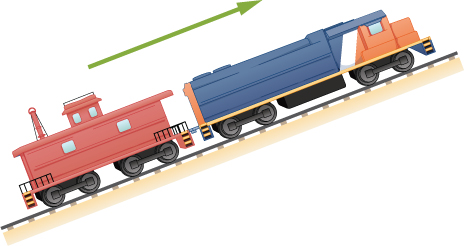
A train is moving up a steep grade at constant velocity (come across following figure) when its caboose breaks loose and starts rolling freely along the rails. Subsequently 5.0 southward, the caboose is 30 chiliad behind the train. What is the dispatch of the caboose?
An electron is moving in a direct line with a velocity of
![\[4.0\,×\,{10}^{5}\]](https://opentextbc.ca/universityphysicsv1openstax/wp-content/ql-cache/quicklatex.com-e942dd2bb11b63952482946b3ecdff54_l3.png "Rendered by QuickLaTeX.com")
m/due south. It enters a region 5.0 cm long where it undergoes an acceleration of
![\[6.0\,×\,{10}^{12}\,{\text{m/s}}^{2}\]](https://opentextbc.ca/universityphysicsv1openstax/wp-content/ql-cache/quicklatex.com-44f4228fe61bcfd7fb7c0d42e4e519d2_l3.png "Rendered by QuickLaTeX.com")
along the same direct line. (a) What is the electron's velocity when information technology emerges from this region? b) How long does the electron accept to cross the region?
[reveal-answer q="fs-id1168055302554″]Show Solution[/reveal-reply]
[hidden-answer a="fs-id1168055302554″]
a.
![\[v=8.7\,×\,{10}^{5}\,\text{m/s}\]](https://opentextbc.ca/universityphysicsv1openstax/wp-content/ql-cache/quicklatex.com-3b8e1eb2020269125c69dc4a9c3fb920_l3.png "Rendered by QuickLaTeX.com")
;
b.
![\[t=7.8\,×\,{10}^{-8}\,\text{s}\]](https://opentextbc.ca/universityphysicsv1openstax/wp-content/ql-cache/quicklatex.com-4507397bf504c1f5f33a464a8efeb7bf_l3.png "Rendered by QuickLaTeX.com")
[/hidden-answer]
An ambulance driver is rushing a patient to the infirmary. While traveling at 72 km/h, she notices the traffic lite at the upcoming intersections has turned amber. To accomplish the intersection before the lite turns red, she must travel l one thousand in ii.0 s. (a) What minimum acceleration must the ambulance have to reach the intersection before the low-cal turns red? (b) What is the speed of the ambulance when information technology reaches the intersection?
A motorcycle that is slowing down uniformly covers 2.0 successive km in 80 s and 120 southward, respectively. Summate (a) the acceleration of the motorcycle and (b) its velocity at the outset and end of the ii-km trip.
[reveal-reply q="fs-id1168057524743″]Show Solution[/reveal-answer]
[hidden-answer a="fs-id1168057524743″]
![\[1\,\text{km}={v}_{0}(80.0\,\text{s})+\frac{1}{2}a{(80.0)}^{2}\]](https://opentextbc.ca/universityphysicsv1openstax/wp-content/ql-cache/quicklatex.com-17256707767432b52f9006d2a8d4d0cf_l3.png "Rendered by QuickLaTeX.com")
;
![\[2\,\text{km}={v}_{0}(200.0)+\frac{1}{2}a{(200.0)}^{2}\]](https://opentextbc.ca/universityphysicsv1openstax/wp-content/ql-cache/quicklatex.com-2200e61af40c6ef93df4d00d078eddc2_l3.png "Rendered by QuickLaTeX.com")
solve simultaneously to get
![\[a=-\frac{0.1}{2400.0}{\text{km/s}}^{2}\]](https://opentextbc.ca/universityphysicsv1openstax/wp-content/ql-cache/quicklatex.com-420cfea3bdd7d4b9ffa8af6498fa4773_l3.png "Rendered by QuickLaTeX.com")
and
![\[{v}_{0}=0.014167\,\text{km/s}\]](https://opentextbc.ca/universityphysicsv1openstax/wp-content/ql-cache/quicklatex.com-732db9c58d28a3593e42865e2ac46c0d_l3.png "Rendered by QuickLaTeX.com")
, which is
![\[51.0\,\text{km/h}\]](https://opentextbc.ca/universityphysicsv1openstax/wp-content/ql-cache/quicklatex.com-10c8d688c0ac13c1d8f208abe927825f_l3.png "Rendered by QuickLaTeX.com")
. Velocity at the end of the trip is
![\[v=21.0\,\text{km/h}\]](https://opentextbc.ca/universityphysicsv1openstax/wp-content/ql-cache/quicklatex.com-7a57927d95d7264de5be9947762e782f_l3.png "Rendered by QuickLaTeX.com")
.
[/hidden-answer]
A cyclist travels from point A to bespeak B in x min. During the first ii.0 min of her trip, she maintains a compatible acceleration of
![\[0.090\,{\text{m/s}}^{2}\]](https://opentextbc.ca/universityphysicsv1openstax/wp-content/ql-cache/quicklatex.com-cfc0476435a6abbfa1f5bb3af5c4c0b9_l3.png "Rendered by QuickLaTeX.com")
. She then travels at abiding velocity for the side by side 5.0 min. Adjacent, she decelerates at a constant rate then that she comes to a rest at indicate B 3.0 min after. (a) Sketch the velocity-versus-fourth dimension graph for the trip. (b) What is the acceleration during the last 3 min? (c) How far does the cyclist travel?
Ii trains are moving at 30 thousand/southward in opposite directions on the aforementioned rails. The engineers encounter simultaneously that they are on a standoff course and utilize the brakes when they are 1000 m autonomously. Bold both trains have the same acceleration, what must this acceleration be if the trains are to end just short of colliding?
[reveal-reply q="fs-id1168055171872″]Show Solution[/reveal-answer]
[hidden-answer a="fs-id1168055171872″]
![\[a=-0.9\,{\text{m/s}}^{2}\]](https://opentextbc.ca/universityphysicsv1openstax/wp-content/ql-cache/quicklatex.com-7ef10d6d45f3a93848449ee14cb9a831_l3.png "Rendered by QuickLaTeX.com")
[/hidden-answer]
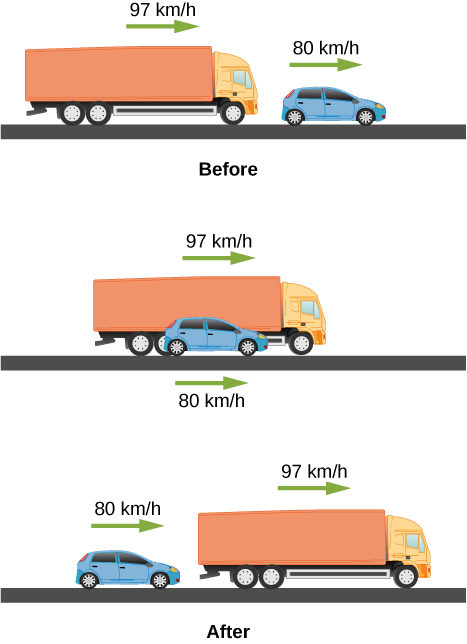
A 10.0-m-long truck moving with a constant velocity of 97.0 km/h passes a three.0-m-long automobile moving with a constant velocity of eighty.0 km/h. How much time elapses between the moment the forepart of the truck is fifty-fifty with the back of the car and the moment the back of the truck is even with the front end of the car?
A police car waits in hiding slightly off the highway. A speeding auto is spotted past the police car doing 40 m/due south. At the instant the speeding car passes the police force car, the police automobile accelerates from rest at 4 m/s2 to take hold of the speeding car. How long does information technology accept the police car to catch the speeding motorcar?
[reveal-answer q="fs-id1168055306834″]Show Solution[/reveal-answer]
[subconscious-answer a="fs-id1168055306834″]
Equation for the speeding car: This car has a abiding velocity, which is the boilerplate velocity, and is not accelerating, then use the equation for displacement with
![\[{x}_{0}=0\]](https://opentextbc.ca/universityphysicsv1openstax/wp-content/ql-cache/quicklatex.com-616245211a4643ae7ddf6553da31af96_l3.png "Rendered by QuickLaTeX.com")
:
![\[x={x}_{0}+\overset{\text{-}}{v}t=\overset{\text{-}}{v}t\]](https://opentextbc.ca/universityphysicsv1openstax/wp-content/ql-cache/quicklatex.com-e4a7bbb4dfa1b2630540a00e958a896a_l3.png "Rendered by QuickLaTeX.com")
; Equation for the constabulary car: This car is accelerating, then use the equation for displacement with
and
![\[{v}_{0}=0\]](https://opentextbc.ca/universityphysicsv1openstax/wp-content/ql-cache/quicklatex.com-fde8a9ba56ce964636befe1e2e0d41a7_l3.png "Rendered by QuickLaTeX.com")
, since the constabulary auto starts from rest:
![\[x={x}_{0}+{v}_{0}t+\frac{1}{2}a{t}^{2}=\frac{1}{2}a{t}^{2}\]](https://opentextbc.ca/universityphysicsv1openstax/wp-content/ql-cache/quicklatex.com-0c61f1e0cdccb8a64bc868ffd33e438d_l3.png "Rendered by QuickLaTeX.com")
; At present we have an equation of motion for each car with a common parameter, which tin can be eliminated to find the solution. In this case, we solve for
![\[t\]](https://opentextbc.ca/universityphysicsv1openstax/wp-content/ql-cache/quicklatex.com-729c191dabfd7d589e4e1b3ed6250b38_l3.png "Rendered by QuickLaTeX.com")
. Step 1, eliminating
![\[x\]](https://opentextbc.ca/universityphysicsv1openstax/wp-content/ql-cache/quicklatex.com-9a51c841875cccf737cdaf2a71188fca_l3.png "Rendered by QuickLaTeX.com")
:
![\[x=\overset{\text{-}}{v}t=\frac{1}{2}a{t}^{2}\]](https://opentextbc.ca/universityphysicsv1openstax/wp-content/ql-cache/quicklatex.com-459fa3889b69a76c8f4b02c3f03e9841_l3.png "Rendered by QuickLaTeX.com")
; Footstep 2, solving for
:
![\[t=\frac{2\overset{\text{-}}{v}}{a}\]](https://opentextbc.ca/universityphysicsv1openstax/wp-content/ql-cache/quicklatex.com-83be3644ce66e8a665e2eb4593233be9_l3.png "Rendered by QuickLaTeX.com")
. The speeding car has a constant velocity of xl thousand/s, which is its average velocity. The acceleration of the police car is iv one thousand/due southii. Evaluating t, the time for the police auto to reach the speeding car, nosotros have
![\[t=\frac{2\overset{\text{-}}{v}}{a}=\frac{2(40)}{4}=20\,\text{s}\]](https://opentextbc.ca/universityphysicsv1openstax/wp-content/ql-cache/quicklatex.com-68577602863588b6222c5e27bcbd68c5_l3.png "Rendered by QuickLaTeX.com")
.
[/subconscious-respond]
Pablo is running in a half marathon at a velocity of three 1000/s. Some other runner, Jacob, is 50 meters backside Pablo with the same velocity. Jacob begins to accelerate at 0.05 m/south2. (a) How long does it accept Jacob to grab Pablo? (b) What is the distance covered by Jacob? (c) What is the final velocity of Jacob?
Unreasonable results A runner approaches the stop line and is 75 m abroad; her boilerplate speed at this position is 8 thousand/s. She decelerates at this signal at 0.five m/sii. How long does information technology take her to cross the finish line from 75 m abroad? Is this reasonable?
[reveal-reply q="fs-id1168055381859″]Show Solution[/reveal-reply]
[hidden-answer a="fs-id1168055381859″]
At this acceleration she comes to a full stop in
![\[t=\frac{-{v}_{0}}{a}=\frac{8}{0.5}=16\,\text{s}\]](https://opentextbc.ca/universityphysicsv1openstax/wp-content/ql-cache/quicklatex.com-3b60e41835ff1264730e37bfeb9e3e7f_l3.png "Rendered by QuickLaTeX.com")
, but the distance covered is
![\[x=8\,\text{m/s(16}\,\text{s)}-\frac{1}{2}(0.5){(16\,\text{s})}^{2}=64\,\text{m}\]](https://opentextbc.ca/universityphysicsv1openstax/wp-content/ql-cache/quicklatex.com-07f5ccbb6c49031443b728ff0fc07c4d_l3.png "Rendered by QuickLaTeX.com")
, which is less than the altitude she is away from the terminate line, and then she never finishes the race.
[/hidden-answer]
An airplane accelerates at 5.0 m/southwardii for 30.0 s. During this time, it covers a distance of 10.0 km. What are the initial and terminal velocities of the airplane?
Compare the distance traveled of an object that undergoes a change in velocity that is twice its initial velocity with an object that changes its velocity by four times its initial velocity over the aforementioned time period. The accelerations of both objects are constant.
[reveal-answer q="fs-id1168055323241″]Bear witness Solution[/reveal-answer]
[subconscious-respond a="fs-id1168055323241″]
![\[{x}_{1}=\frac{3}{2}{v}_{0}t\]](https://opentextbc.ca/universityphysicsv1openstax/wp-content/ql-cache/quicklatex.com-e10b0d64ac78f8435fc7c374a4ecfea1_l3.png "Rendered by QuickLaTeX.com")
![\[{x}_{2}=\frac{5}{3}{x}_{1}\]](https://opentextbc.ca/universityphysicsv1openstax/wp-content/ql-cache/quicklatex.com-62d43eb08376b2547d021d8ca4d27ac6_l3.png "Rendered by QuickLaTeX.com")
[/subconscious-respond]
An object is moving due east with a constant velocity and is at position
![\[{x}_{0}\,\text{at}\,\text{time}\,{t}_{0}=0\]](https://opentextbc.ca/universityphysicsv1openstax/wp-content/ql-cache/quicklatex.com-c958fb9d2dbde5677335d098e6cf452a_l3.png "Rendered by QuickLaTeX.com")
. (a) With what acceleration must the object have for its total displacement to be zero at a later time t ? (b) What is the physical interpretation of the solution in the case for
![\[t\to \infty\]](https://opentextbc.ca/universityphysicsv1openstax/wp-content/ql-cache/quicklatex.com-1b3b4f1d17f7a1724f848afe3d600bc7_l3.png "Rendered by QuickLaTeX.com")
?
A ball is thrown straight up. It passes a 2.00-m-loftier window 7.fifty m off the footing on its path up and takes one.30 s to become by the window. What was the ball'southward initial velocity?
[reveal-answer q="fs-id1168055391633″]Testify Solution[/reveal-answer]
[subconscious-answer a="fs-id1168055391633″]
![\[{v}_{0}=7.9\,\text{m/s}\]](https://opentextbc.ca/universityphysicsv1openstax/wp-content/ql-cache/quicklatex.com-90ef5ff35350a87b987d6a6a7d6030f0_l3.png "Rendered by QuickLaTeX.com")
velocity at the bottom of the window.
![\[v=7.9\,\text{m/s}\]](https://opentextbc.ca/universityphysicsv1openstax/wp-content/ql-cache/quicklatex.com-46fdffddc9c38d2e9919c8e326340f01_l3.png "Rendered by QuickLaTeX.com")
![\[{v}_{0}=14.1\,\text{m/s}\]](https://opentextbc.ca/universityphysicsv1openstax/wp-content/ql-cache/quicklatex.com-ee944f4a089c96d6191ca07f17ff6508_l3.png "Rendered by QuickLaTeX.com")
[/hidden-answer]
A money is dropped from a hot-air balloon that is 300 m in a higher place the basis and rising at ten.0 yard/south upwards. For the money, discover (a) the maximum top reached, (b) its position and velocity 4.00 s after being released, and (c) the time before it hits the ground.
A soft lawn tennis ball is dropped onto a hard flooring from a height of one.l chiliad and rebounds to a height of ane.10 one thousand. (a) Calculate its velocity just before it strikes the flooring. (b) Calculate its velocity but after it leaves the floor on its fashion back upward. (c) Calculate its acceleration during contact with the floor if that contact lasts iii.50 ms
![\[(3.50\,×\,{10}^{-3}\,\text{s})\]](https://opentextbc.ca/universityphysicsv1openstax/wp-content/ql-cache/quicklatex.com-2f78f659e3a75ba4ba7612650ce03d44_l3.png "Rendered by QuickLaTeX.com")
(d) How much did the ball compress during its standoff with the flooring, assuming the floor is admittedly rigid?
[reveal-answer q="fs-id1168055325521″]Show Solution[/reveal-reply]
[subconscious-answer a="fs-id1168055325521″]
a.
![\[v=5.42\,\text{m/s}\]](https://opentextbc.ca/universityphysicsv1openstax/wp-content/ql-cache/quicklatex.com-880b612a492c6f87b6c24ef17923060c_l3.png "Rendered by QuickLaTeX.com")
;
b.
![\[v=4.64\,\text{m/s}\]](https://opentextbc.ca/universityphysicsv1openstax/wp-content/ql-cache/quicklatex.com-c9896881eaddcb8fef97ee3930973a81_l3.png "Rendered by QuickLaTeX.com")
;
c.
![\[a=2874.28\,{\text{m/s}}^{2}\]](https://opentextbc.ca/universityphysicsv1openstax/wp-content/ql-cache/quicklatex.com-24f812bc0f59f4835b60b6ba79d7d8fa_l3.png "Rendered by QuickLaTeX.com")
;
d.
![\[(x-{x}_{0})=5.11\,×\,{10}^{-3}\,\text{m}\]](https://opentextbc.ca/universityphysicsv1openstax/wp-content/ql-cache/quicklatex.com-16ee1206c50b1f87ab7f2f8e5aa351e3_l3.png "Rendered by QuickLaTeX.com")
[/subconscious-answer]
Unreasonable results. A raindrop falls from a deject 100 g above the footing. Neglect air resistance. What is the speed of the raindrop when it hits the basis? Is this a reasonable number?
Compare the time in the air of a basketball game role player who jumps i.0 m vertically off the floor with that of a player who jumps 0.3 m vertically.
[reveal-answer q="fs-id1168057418927″]Testify Solution[/reveal-answer]
[hidden-answer a="fs-id1168057418927″]
Consider the players autumn from rest at the meridian ane.0 m and 0.3 m.
0.nine s
0.5 s
[/hidden-answer]
Suppose that a person takes 0.5 due south to react and move his mitt to catch an object he has dropped. (a) How far does the object fall on Globe, where
![\[g=9.8\,{\text{m/s}}^{2}?\]](https://opentextbc.ca/universityphysicsv1openstax/wp-content/ql-cache/quicklatex.com-ef8ceb017918edef017fd082d5029101_l3.png "Rendered by QuickLaTeX.com")
(b) How far does the object fall on the Moon, where the acceleration due to gravity is 1/6 of that on Earth?
A hot-air balloon rises from ground level at a constant velocity of 3.0 m/s. One minute after liftoff, a sandbag is dropped accidentally from the balloon. Calculate (a) the time it takes for the sandbag to reach the ground and (b) the velocity of the sandbag when it hits the ground.
[reveal-answer q="fs-id1168055469821″]Show Solution[/reveal-answer]
[hidden-answer a="fs-id1168055469821″]
a.
![\[t=6.37\,\text{s}\]](https://opentextbc.ca/universityphysicsv1openstax/wp-content/ql-cache/quicklatex.com-95b85c1a3f75cb15f708d981232a4134_l3.png "Rendered by QuickLaTeX.com")
taking the positive root;
b.
![\[v=59.5\,\text{m/s}\]](https://opentextbc.ca/universityphysicsv1openstax/wp-content/ql-cache/quicklatex.com-fb9e466d0ea2be7e3c9963245b60b7ff_l3.png "Rendered by QuickLaTeX.com")
[/subconscious-reply]
(a) A world tape was fix for the men'south 100-m dash in the 2008 Olympic Games in Beijing by Usain Bolt of Jamaica. Bolt "coasted" across the finish line with a fourth dimension of 9.69 s. If we presume that Commodities accelerated for iii.00 due south to reach his maximum speed, and maintained that speed for the residual of the race, summate his maximum speed and his dispatch. (b) During the same Olympics, Commodities besides set the world record in the 200-m dash with a fourth dimension of 19.30 s. Using the same assumptions as for the 100-m dash, what was his maximum speed for this race?
An object is dropped from a pinnacle of 75.0 m higher up ground level. (a) Decide the distance traveled during the first 2d. (b) Determine the final velocity at which the object hits the ground. (c) Determine the altitude traveled during the last second of motility before hitting the basis.
[reveal-answer q="fs-id1168055273683″]Show Solution[/reveal-answer]
[hidden-answer a="fs-id1168055273683″]
a.
![\[y=4.9\,\text{m}\]](https://opentextbc.ca/universityphysicsv1openstax/wp-content/ql-cache/quicklatex.com-74603465c34a222eb76c07567f928574_l3.png "Rendered by QuickLaTeX.com")
;
b.
![\[v=38.3\,\text{m/s}\]](https://opentextbc.ca/universityphysicsv1openstax/wp-content/ql-cache/quicklatex.com-5d0240eb990cbd0b8eac6ad0a2006e92_l3.png "Rendered by QuickLaTeX.com")
;
c.
![\[-33.3\,\text{m}\]](https://opentextbc.ca/universityphysicsv1openstax/wp-content/ql-cache/quicklatex.com-c57e362b2f6dbf477ec65cd874f0b87b_l3.png "Rendered by QuickLaTeX.com")
[/subconscious-respond]
A steel ball is dropped onto a hard floor from a pinnacle of 1.50 thou and rebounds to a height of i.45 m. (a) Summate its velocity merely before it strikes the floor. (b) Calculate its velocity just afterwards information technology leaves the floor on its manner back upwards. (c) Calculate its acceleration during contact with the floor if that contact lasts 0.0800 ms
![\[(8.00\,×\,{10}^{-5}\,\text{s})\]](https://opentextbc.ca/universityphysicsv1openstax/wp-content/ql-cache/quicklatex.com-2380df21bcd1d0db103b860a0952169e_l3.png "Rendered by QuickLaTeX.com")
(d) How much did the ball shrink during its collision with the floor, bold the floor is admittedly rigid?
An object is dropped from a roof of a building of elevation h. During the terminal second of its descent, information technology drops a distance h/3. Calculate the tiptop of the edifice.
[reveal-answer q="fs-id1168055491899″]Show Solution[/reveal-answer]
[hidden-answer a="fs-id1168055491899″]
![\[h=\frac{1}{2}g{t}^{2}\]](https://opentextbc.ca/universityphysicsv1openstax/wp-content/ql-cache/quicklatex.com-35d74c7a403d044e6765a8e4b950ad72_l3.png "Rendered by QuickLaTeX.com")
, h = total meridian and fourth dimension to drop to ground
![\[\frac{2}{3}h=\frac{1}{2}g{(t-1)}^{2}\]](https://opentextbc.ca/universityphysicsv1openstax/wp-content/ql-cache/quicklatex.com-2cf185e34d7b5ff96ee5f7afcb985ce2_l3.png "Rendered by QuickLaTeX.com")
in t – ane seconds it drops 2/3h
![\[\frac{2}{3}(\frac{1}{2}g{t}^{2})=\frac{1}{2}g{(t-1)}^{2}\]](https://opentextbc.ca/universityphysicsv1openstax/wp-content/ql-cache/quicklatex.com-42791279034da3704591cb1b7fc3fba1_l3.png "Rendered by QuickLaTeX.com")
or
![\[\frac{{t}^{2}}{3}=\frac{1}{2}{(t-1)}^{2}\]](https://opentextbc.ca/universityphysicsv1openstax/wp-content/ql-cache/quicklatex.com-eff9fc71c6db42bcef3774797aeeefcb_l3.png "Rendered by QuickLaTeX.com")
![\[0={t}^{2}-6t+3\]](https://opentextbc.ca/universityphysicsv1openstax/wp-content/ql-cache/quicklatex.com-79c218fe337cdca30ec3b420e024f6e8_l3.png "Rendered by QuickLaTeX.com")
![\[t=\frac{6±\sqrt{{6}^{2}-4·3}}{2}=3±\frac{\sqrt{24}}{2}\]](https://opentextbc.ca/universityphysicsv1openstax/wp-content/ql-cache/quicklatex.com-16a4796d674cafaaf0d914e087cb2e96_l3.png "Rendered by QuickLaTeX.com")
t = 5.45 southward and h = 145.5 m. Other root is less than 1 s. Check for t = iv.45 s
![\[h=\frac{1}{2}g{t}^{2}=97.0\]](https://opentextbc.ca/universityphysicsv1openstax/wp-content/ql-cache/quicklatex.com-5705e9d536ccddd8e9edf29d1761e207_l3.png "Rendered by QuickLaTeX.com")
m
![\[=\frac{2}{3}(145.5)\]](https://opentextbc.ca/universityphysicsv1openstax/wp-content/ql-cache/quicklatex.com-18624796e4bd16b52c56c3eb3f60cce2_l3.png "Rendered by QuickLaTeX.com")
[/hidden-answer]
Challenge Problems
In a 100-m race, the winner is timed at 11.2 s. The second-identify finisher's time is 11.6 s. How far is the second-place finisher backside the winner when she crosses the finish line? Assume the velocity of each runner is abiding throughout the race.
The position of a particle moving along the x-centrality varies with time according to
![\[x(t)=5.0{t}^{2}-4.0{t}^{3}\]](https://opentextbc.ca/universityphysicsv1openstax/wp-content/ql-cache/quicklatex.com-d267d3d1d58b9049200a10971752a19e_l3.png "Rendered by QuickLaTeX.com")
one thousand. Find (a) the velocity and acceleration of the particle as functions of time, (b) the velocity and acceleration at t = 2.0 s, (c) the fourth dimension at which the position is a maximum, (d) the time at which the velocity is cipher, and (e) the maximum position.
[reveal-reply q="fs-id1168055269782″]Show Solution[/reveal-answer]
[hidden-reply a="fs-id1168055269782″]
a.
![\[v(t)=10t-12{t}^{2}\text{m/s,}\,a(t)=10-24t\,{\text{m/s}}^{2}\]](https://opentextbc.ca/universityphysicsv1openstax/wp-content/ql-cache/quicklatex.com-0c0815d457ebad1ed7935a3eb22437b4_l3.png "Rendered by QuickLaTeX.com")
;
b.
![\[v(2\,\text{s})=-28\,\text{m/s,}\,a(2\,\text{s})=-38{\text{m/s}}^{2}\]](https://opentextbc.ca/universityphysicsv1openstax/wp-content/ql-cache/quicklatex.com-3a8e7376e599acbc505d7d202ee03c1a_l3.png "Rendered by QuickLaTeX.com")
; c. The slope of the position part is zero or the velocity is nix. At that place are two possible solutions: t = 0, which gives x = 0, or t = x.0/12.0 = 0.83 s, which gives ten = 1.16 k. The 2nd answer is the correct choice; d. 0.83 s (eastward) one.16 grand
[/subconscious-answer]
A cyclist sprints at the end of a race to clinch a victory. She has an initial velocity of eleven.5 m/due south and accelerates at a charge per unit of 0.500 m/s2 for 7.00 southward. (a) What is her final velocity? (b) The cyclist continues at this velocity to the terminate line. If she is 300 thou from the finish line when she starts to accelerate, how much fourth dimension did she save? (c) The second-place winner was 5.00 grand alee when the winner started to accelerate, only he was unable to accelerate, and traveled at eleven.8 m/due south until the finish line. What was the difference in cease time in seconds between the winner and runner-upward? How far dorsum was the runner-upwardly when the winner crossed the finish line?
In 1967, New Zealander Burt Munro set the world record for an Indian motorcycle, on the Bonneville Salt Flats in Utah, of 295.38 km/h. The one-way course was 8.00 km long. Dispatch rates are often described by the fourth dimension it takes to achieve 96.0 km/h from balance. If this time was four.00 due south and Burt accelerated at this charge per unit until he reached his maximum speed, how long did it take Burt to complete the course?
[reveal-answer q="fs-id1168057239219″]Bear witness Solution[/reveal-answer]
[hidden-answer a="fs-id1168057239219″]
![\[96\,\text{km/h}=26.67\,\text{m/s,}\,a=\frac{26.67\,\text{m/s}}{4.0\,\text{s}}=6.67{\text{m/s}}^{2}\]](https://opentextbc.ca/universityphysicsv1openstax/wp-content/ql-cache/quicklatex.com-acf6a350bbed26b6eef2945eb27fa5b3_l3.png "Rendered by QuickLaTeX.com")
, 295.38 km/h = 82.05 m/southward,
![\[t=12.3\,\text{s}\]](https://opentextbc.ca/universityphysicsv1openstax/wp-content/ql-cache/quicklatex.com-8e06bd37f82e114d767b591c5d512e02_l3.png "Rendered by QuickLaTeX.com")
time to accelerate to maximum speed
![\[x=504.55\,\text{m}\]](https://opentextbc.ca/universityphysicsv1openstax/wp-content/ql-cache/quicklatex.com-f69f5d89904fd208c8e93baa48399b22_l3.png "Rendered by QuickLaTeX.com")
distance covered during dispatch
![\[7495.44\,\text{m}\]](https://opentextbc.ca/universityphysicsv1openstax/wp-content/ql-cache/quicklatex.com-8fe707b137d9e7e68d49f24df5770aff_l3.png "Rendered by QuickLaTeX.com")
at a constant speed
![\[\frac{7495.44\,\text{m}}{82.05\,\text{m/s}}=91.35\,\text{s}\]](https://opentextbc.ca/universityphysicsv1openstax/wp-content/ql-cache/quicklatex.com-bbcde0c0d03cdacd7946a058f05500a2_l3.png "Rendered by QuickLaTeX.com")
so total time is
![\[91.35\,\text{s}+12.3\,\text{s}=103.65\,\text{s}\]](https://opentextbc.ca/universityphysicsv1openstax/wp-content/ql-cache/quicklatex.com-7d69cf16094a355e7ac6a8f0fb44eaaf_l3.png "Rendered by QuickLaTeX.com")
.
[/hidden-answer]
newberrythaddlead.blogspot.com
Source: https://opentextbc.ca/universityphysicsv1openstax/chapter/3-6-finding-velocity-and-displacement-from-acceleration/
0 Response to "what distance did the person move from t = 2.0 s to t= 4.0 s?"
Postar um comentário